Combat Optics: A Guide to Tactical Rifle Sights and Scopes
Pick the wrong optic and everything downstream suffers. Slower target acquisition. Worse hit probability. A rifle that looks the part but doesn’t perform when it counts.
Combat optics are not a single category. The term covers red dots, LPVOs, holographic sights, and traditional magnified scopes, each built for a different job. This guide breaks down the tactical optics landscape by type, explains where each one earns its keep on an AR-platform rifle, and gives you a framework for choosing between a red dot, an LPVO, and a traditional rifle scope.
What Qualifies as a Combat Optic
A combat optic has to do three things well: get you on target fast, hold zero under abuse, and work across the lighting conditions you’re likely to face. Miss any one of those and the optic is a liability dressed up as gear.
Military and law enforcement adoption is the clearest signal of real-world performance. Optics carried by infantry units, special forces, and SWAT teams have already survived the testing that matters: repeated deployment, harsh environments, and use under stress. That track record separates genuine tactical rifle scopes from optics that just borrow combat branding.
Four traits show up again and again in optics with legitimate combat pedigree:
- Fast target acquisition, ideally faster than iron sights
- Field-proven durability, not just lab-tested durability
- Reliable low-light and variable-light performance
- Simple operation that doesn’t demand fine motor control under stress
Every optic type below gets measured against that standard.
Types of Combat Optics
Tactical rifle scopes break into four broad families: red dot and reflex sights, LPVOs, holographic sights, and magnified rifle scopes. Each has a distinct role.
| Optic Type | Magnification | Best Use Case | Battery Dependent |
|---|---|---|---|
| Red dot / reflex | 1x fixed | CQB, home defense, fast target acquisition | Yes (long life) |
| Holographic sight | 1x fixed | CQB with wider viewing window | Yes |
| LPVO | 1-6x to 1-10x | Versatile CQB through mid-range | Yes (illumination) |
| Prism scope | Fixed 3x-6x | Mid-range, no-battery reliability | No (etched reticle) |
| Traditional rifle scope | Variable, 6x+ | Extended range, precision shooting | No |
That table is the quick-reference version. The sections below cover each category in depth.
Red Dot and Reflex Sights
Red dot sights are the fastest way to get a rifle on target. At 1x magnification with a simple illuminated dot reticle, there’s no scope shadow, no eye relief to manage precisely, and no parallax at realistic engagement distances. You keep both eyes open, put the dot on the threat, and press the trigger.
This category has the deepest combat history of any optic type. The Aimpoint CompM series has served as the U.S. Army’s M68 Close Combat Optic for decades, and the current-generation CompM5 runs roughly five years on a single AAA battery. The Trijicon MRO fills a similar role with a compact housing built for AR-platform rifles. For pistol-mounted red dot sights, the Trijicon RMR proved the concept works on handguns too, and that footprint has become the industry standard for slide-mounted optics.
Reflex sights matter most inside 50 yards. Beyond that, the dot itself starts to obscure smaller or more distant targets, which is where magnified optics take over.
LPVOs for Tactical Rifles
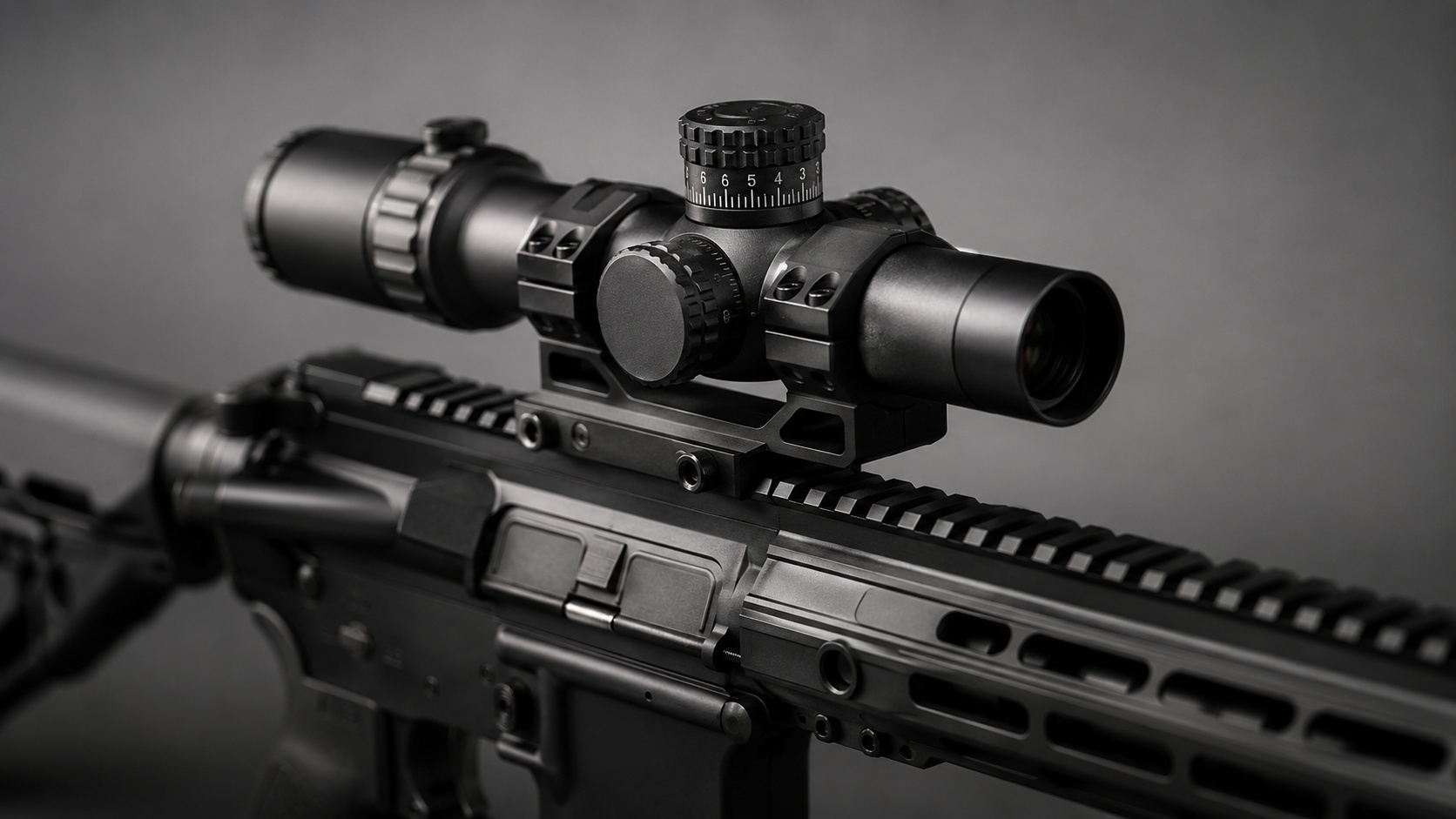
Low power variable optics, or LPVOs, solve a real problem: most shooters don’t know their exact engagement distance in advance. An LPVO in 1-6x or 1-8x lets you run 1x for CQB speed and dial up magnification when the situation calls for it.
At 1x, a quality LPVO performs close to a red dot sight, though rarely quite as fast. Crank it to 6x or 8x and you get enough resolution for positive target identification out to 200 yards or beyond. That flexibility is why the U.S. military adopted the 1-8x LPVO as the Squad Common Optic, replacing fixed-power optics on a huge number of service rifles.
The tradeoff is weight and complexity. An LPVO is heavier than a red dot, requires more precise eye relief management at higher magnification, and costs more. For a dedicated CQB gun, that tradeoff may not be worth it. For a general-purpose AR optic that needs to handle multiple engagement distances, it usually is.
Look for illuminated reticles with both close-range dot references and holdover marks for mid-range shots. The Vortex Razor HD Gen III and the Trijicon VCOG both deliver this in a rugged, combat-rated package.
Holographic Sights
Holographic sights work on a different optical principle than reflex sights, using a laser to project a holographic reticle image onto the viewing window. The practical result is a wider field of view and a reticle that stays sharp even if the window itself gets scratched or partially obscured.
EOTech built its reputation on this technology, and its holographic weapon sights have seen use with special forces and SWAT teams for years. The wider window makes target transitions faster for a lot of shooters, which matters in close-quarters combat where multiple threats can appear in quick succession.
The main downside is battery consumption. Holographic sights draw more power than a simple LED reflex sight, so battery life tends to be measured in hundreds of hours rather than years. If you’re running one as a primary defensive optic, keep spare batteries in your kit.
Traditional Rifle Scopes and Prism Optics
Not every combat scenario happens inside 50 yards. When engagement distance stretches past 200 yards, you need real magnification and a reticle built for holdovers.
Prism scopes bridge the gap between red dots and full magnified scopes. The Trijicon ACOG, fixed at 4x, is the best-known example and has served as the USMC Rifle Combat Optic since the early 2000s. Its etched glass reticle works with zero battery dependency: no power, no fiber optic light source, and the reticle is still there because it’s physically cut into the glass. For anyone who wants a combat optic that simply cannot go dark, that’s a meaningful advantage.
Beyond prism scopes, dedicated variable-magnification rifle scopes take over for genuine long-range work. First focal plane (FFP) reticles keep your holdover references accurate at any magnification setting, which matters if you’re actually going to use those hash marks under pressure. Second focal plane (SFP) reticles are only accurate at one zoom level, and remembering which one in a stressful situation is not a bet worth making.
Combat Optics for AR-Platform Rifles
The AR-15 platform dominates the tactical rifle scope market, but it’s far from the only rifle worth optimizing glass for. A handful of other platforms show up constantly in combat optics discussions, each with its own mounting considerations.
AR-10 scopes follow the same optical logic as AR-15 optics but need to account for the heavier recoil impulse of .308-class cartridges. Mount durability matters more here than on a 5.56 rifle. A red dot or LPVO that holds zero on an AR-15 can occasionally shift under repeated .308 recoil if the mount isn’t rated for it.
SCAR 17 optics face a similar consideration. The SCAR 17’s recoil profile and rail geometry mean shooters often lean toward LPVOs or prism scopes over pure red dots, since the extra magnification range pays off on a rifle typically used at longer engagement distances than a standard carbine.
Tavor optics come with a unique challenge: the bullpup configuration puts the optic much farther forward relative to the shooter’s eye than a standard AR platform, which changes eye relief requirements. LPVOs and prism scopes with generous eye relief tend to work better on a Tavor than optics designed with a standard AR cheek weld in mind.
Across all three platforms, mount quality determines whether the optic performs as advertised. A combat-rated optic on a budget mount is still a budget system. Match the mount to the recoil impulse of the platform, torque it to spec, and confirm zero before it matters.
Choosing Between a Red Dot, LPVO, and Traditional Rifle Scope
There’s no universally correct answer here. The right choice depends on your most likely engagement distance and how much versatility you need from a single optic.
- Choose a red dot if your engagement distance is consistently inside 50 yards. Home defense, CQB training, and dedicated close-range rifles all favor the speed of a 1x reflex or holographic sight over anything with magnification.
- Choose an LPVO if you need one optic to cover both close-range speed and mid-range precision. This is the right call for a general-purpose AR-platform rifle where you don’t know in advance what distance you’ll be engaging at.
- Choose a traditional rifle scope if your engagement distance regularly extends past 200 yards. Designated marksman roles, rural property defense with long sightlines, and any scenario requiring positive target identification at distance all call for real magnification.
- Choose a prism scope if you want combat-proven reliability with zero battery dependency, in exchange for giving up variable zoom.
A red dot with magnifier is worth mentioning as a hybrid option. Running a fixed 1x reflex sight with a flip-to-side magnifier gives you red-dot speed by default and on-demand magnification when you need it, without the added weight of a full LPVO. It’s a common setup among shooters who want CQB speed as the priority but don’t want to give up mid-range capability entirely.
The Hard Baseline
Every optic on this list can perform if it’s matched correctly to the rifle, the mission, and the shooter running it. None of them perform if they’re mismatched to the engagement distance you actually face.
Start with your most likely scenario. Build the optic selection around that, not around what looks impressive on a rail. Mount it properly, confirm zero, and put enough rounds through the system that using the optic becomes reflexive rather than something you have to think about.
That’s what turns a tactical rifle scope into a combat optic. Not the label on the box. The performance behind it.